Travel Tips
Vietnam vs Cambodia: Which Should You Visit?
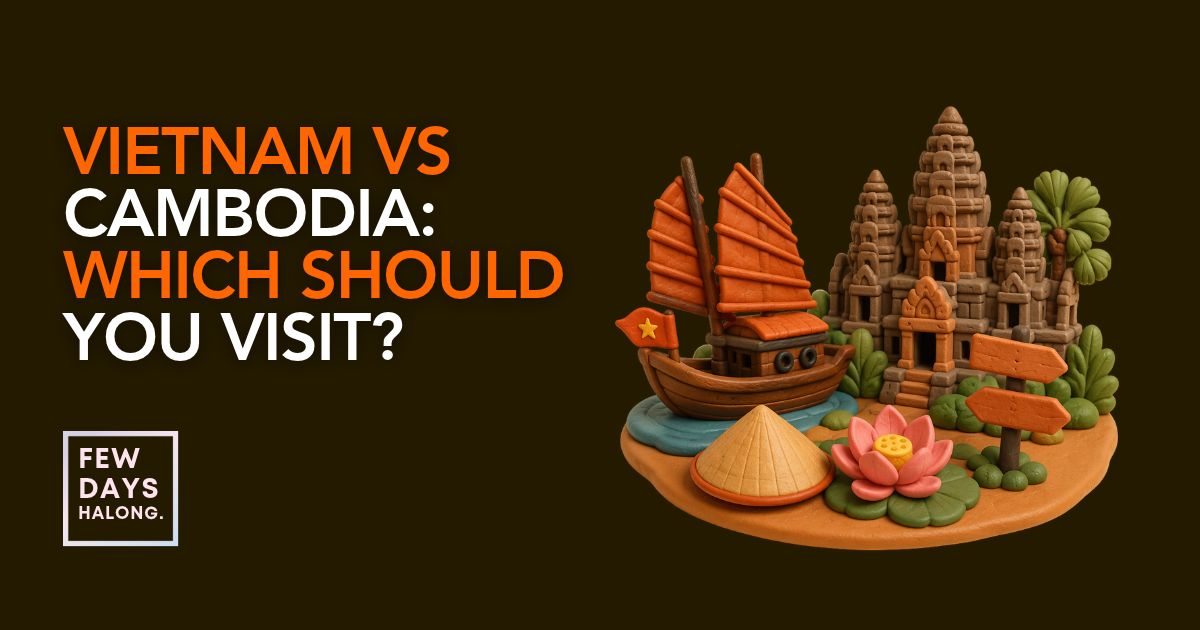
Vietnam vs Cambodia: the honest short answer
These two neighbours are often weighed against each other, and they reward quite different travellers. Vietnam is long, varied and fast moving: in two weeks you can go from the limestone bays of the north to the old towns of the centre and the delta of the south, eating brilliantly the whole way. Cambodia is smaller, slower and quieter, and its single greatest draw, the temples of Angkor near Siem Reap, is reason enough on its own.
For a first trip to the region, most people get more out of Vietnam simply because it packs more scenery, cities and food into one country. If your heart is set on Angkor, or you want a calmer, more low-key trip, Cambodia wins. And because they share a border and a short flight, the real answer for many travellers is not one or the other but both, which we come to below.
Scenery and landscapes
This is where Vietnam pulls ahead. The country runs more than 1,600 kilometres from north to south, so the landscapes change constantly: the karst islands of Ha Long and Lan Ha bays, the rice terraces and mountains around Sapa, the caves and rivers of Ninh Binh, a long central coastline, and the green waterways of the Mekong Delta. You are rarely more than a short hop from somewhere that looks completely different.
Cambodia is flatter and more uniform, built around the vast Tonle Sap lake and the Mekong. Its scenery is gentler, think floating villages, palm-dotted rice fields and a quiet southern coast. It is calming rather than dramatic. If landscapes and variety are what move you, Vietnam has more to show. Our guide to how many days you need in Vietnam gives a sense of how much ground a trip can cover.
Temples, history and culture
Here Cambodia has the trump card. Angkor, outside Siem Reap, is the largest religious monument in the world and one of the most remarkable places anywhere in Asia. Angkor Wat itself, the Bayon with its carved faces, and Ta Prohm with its tree roots are on a scale Vietnam has nothing to match. A multi-day pass and a couple of early starts are the heart of almost any Cambodia trip.
Vietnam's history is spread out rather than concentrated in one site: the old quarter of Hanoi, the imperial citadel of Hue, the lantern-lit streets of Hoi An, the war history of the south and the French-era architecture throughout. It is a thousand years of layered culture you travel through, rather than one great complex you base a trip around. If a single, awe-inspiring ancient wonder is your priority, Cambodia. If you prefer culture woven through everyday life as you move, Vietnam.
Food
Vietnam is one of the great food countries of the world, and for many travellers it is reason enough to go. Pho, banh mi, fresh spring rolls, regional specialities that change as you travel, herbs and balance everywhere, and some of the best street eating on the planet, almost all of it inexpensive. It is varied, light and endlessly moreish.
Cambodian food, Khmer cuisine, is milder and less known, and well worth trying: fish amok, lok lak, fresh river fish and Kampot pepper dishes. It is gentle and comforting rather than bold. Both are good, but if eating is central to your holiday, Vietnam is the stronger choice. Our piece on whether Vietnam is expensive covers just how affordable the food is.
Beaches and islands
Both countries have a coastline, and neither is primarily a beach destination in the way Thailand is, but both have good options. Vietnam has a long coast with resort towns, the island of Phu Quoc in the south, and quieter stretches near Hoi An and Nha Trang, so a few beach days slot easily into a wider trip.
Cambodia's coast around Sihanoukville and the islands of Koh Rong and Koh Rong Sanloem offer simple, laid-back beach time, though the mainland town has changed a lot in recent years. For most travellers the beaches are a relaxing add-on to either trip rather than the main event. If you want beaches to be the centrepiece, that is a different conversation, and one we are happy to have when we plan your route.
Cost and value for money
Both are affordable by Western standards, and day-to-day costs, food, local transport, entry fees, are low in each. Vietnam offers slightly better value across the board because it has more competition and a bigger tourism industry, so hotels in particular give you more for your money. Cambodia can work out a touch more expensive in Siem Reap, where the Angkor pass and guides are a real and worthwhile cost.
Neither will stretch a sensible budget, and both can be done comfortably without spending a lot. For a full picture of what a trip actually costs, our guide to how much a Vietnam trip costs breaks it down by travel style.
Would you rather have this planned for you?
We are private Vietnam specialists, not resellers. Tell us your dates and we will build a tailor-made itinerary and run the whole trip for you, arrival to departure. Rated five-star on Tripadvisor.
Get your free personalised itinerary ›Getting around, weather and visas in 2026
Vietnam is long, so a trip usually involves a couple of short internal flights plus trains, cars and transfers to link the north, centre and south. Cambodia is compact, and most trips revolve around Siem Reap, Phnom Penh and perhaps the coast, linked by short drives or quick flights.
On weather, both share a tropical pattern with a dry season roughly November to April and a wet season through the summer, though Vietnam's length means the north and south can differ on the same dates. Our guide to the best time to visit Vietnam explains the regional timing. On visas, most visitors enter Vietnam visa-free or on a simple e-visa, while Cambodia issues an e-visa or visa on arrival for most nationalities for a modest fee. Our full guide to Vietnam visas covers the detail, and always check your own nationality before you travel.
Can you visit both in one trip?
Yes, and it is one of the best things about this part of Asia. Vietnam and Cambodia share a border, flights between the main cities are short and cheap, and the two combine naturally into one trip. A classic route pairs Vietnam from north to south, Hanoi, Ha Long Bay, the centre and the Mekong Delta, then hops across to Siem Reap for a few days at Angkor to finish.
You can also travel overland between the Mekong Delta and Phnom Penh, which many people enjoy as a scenic river crossing. If you have two to three weeks, doing both gives you Vietnam's variety and Cambodia's great temples in a single journey. This kind of multi-country route, with the flights, the border and the timing all joined up, is exactly what we build for people. Our 14-day Vietnam itinerary is the backbone most add a Cambodia leg onto.
So which should you choose?
To boil it down: choose Vietnam for variety, scenery, food and value in a single country, which makes it the stronger first trip for most people. Choose Cambodia if Angkor is the whole point of the journey, or if you want a slower, quieter, more compact trip. And if you can spare the time, do both, because they sit side by side and complement each other better than almost any two countries in the region.
The honest truth is that there is no wrong answer, only the trip that fits you. The part worth getting right is the route and the timing, and that is where a bit of planning earns its keep.
How we plan your Vietnam trip
Working out how long to give each country, which order to travel in, where to fly and where to cross the border, and how to fit Angkor in without rushing, is exactly the kind of thing we take off your hands. We are private Vietnam specialists, not resellers, so we plan the route around what you want to see rather than around what pays us, and we never take commission. We book the flights, arrange the drivers and guides, and run the whole trip for you from arrival to departure.
We are rated five-star on Tripadvisor. Tell us roughly when you want to travel and whether you are leaning Vietnam, Cambodia or both, and we will build a route around it. Read why it is worth booking a private Vietnam trip, or go straight to a free personalised itinerary.
Common questions
Is Vietnam or Cambodia better to visit?
For most first trips Vietnam is the richer choice, because it packs more scenery, cities, coastline and food into one country and offers slightly better value. Cambodia is the better pick if the temples of Angkor are your main reason for going, or if you want a slower, more compact trip. Many travellers visit both.
Should I visit Vietnam or Cambodia first?
If you are doing both, most people travel Vietnam from north to south and finish in Cambodia at Siem Reap, so Angkor is the grand finale. You can also go the other way. Either works, and the right order often depends on your international flights, which is something we line up when we plan the route.
Can you visit Vietnam and Cambodia in one trip?
Yes, and it is a popular combination. The two share a border, flights between the main cities are short and cheap, and you can also travel overland between the Mekong Delta and Phnom Penh. With two to three weeks you can see the best of Vietnam and add a few days at Angkor.
How many days do you need for Vietnam and Cambodia?
For Vietnam alone, around ten days to two weeks works well. To combine both comfortably, allow two to three weeks: roughly ten to fourteen days in Vietnam and three to four days in Siem Reap for Angkor, plus travel time between them.
Is Cambodia cheaper than Vietnam?
They are broadly similar and both are affordable, but Vietnam tends to offer slightly better value overall, especially on hotels. Siem Reap can cost a little more because of the Angkor pass and guides, which are well worth the money.
Is Vietnam or Cambodia better for food?
Vietnam, for most people. Its cuisine is one of the most celebrated in the world, varied, fresh and inexpensive. Cambodian food is milder and less known but well worth trying, with dishes like fish amok and lok lak. If food is central to your trip, Vietnam has the edge.
Thinking about Vietnam, Cambodia or both?
Get your free personalised itinerary ›